 English

 New goods

Description
The chemical industry is one of the most dynamically developing sectors of the economy all over the world, including in the Russian Federation and CIS countries.
In the Russian Federation, there is a state program for the development of the chemical and processing industry, and a significant increase in the output is forecasted. At the same time, the cost of shipping cargo is often a deterrent to the sale of goods in foreign and domestic markets.
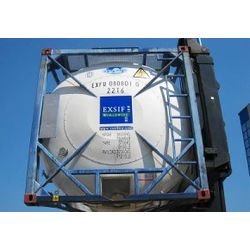
Transportations in tank containers allow to solve this problem, as well as problems of delivery of dangerous goods to hard-to-reach areas with the lack of railway infrastructure and preservation of the initial quality.
For transportation of chemical cargoes the tank-container IMO1, types T11 (with bottom drain) or Т14 (with the top discharge) is used. They are suitable for the transport of all types of bulk chemical cargo.
The capacity of the tank-container of this type is from 21 to 26 cubic meters, the thickness of the walls of the bulb is from 4 to 7 mm. The working pressure of the bulb of the tank is from 2.65 to 4.5 atmospheres.
Containers are equipped with a layer of thermal insulation and steam heating.
For certain types of cargo containers are equipped with electric heating.
The main chemical goods allowed for transportation:
* Alcohols (isobutyl, isopropyl, methyl, isopropyl)
* Ethylene glycols (monoethylene glycols)
* Acids (sulfuric, hydrochloric, acetic, phosphoric)
* Vinyl acetate (butyl acetate)
* Phenol
* Achenion
* Benzene (methylbenzene)
* Aniline
* Xylenes (ortho-, meta-, para-)
* Lignosulfonates
* formalin
* resins (formaldehyde, urea-formaldehyde)
* paraffin
* naphthalene
* and other cargoes